Is my tree dying? Visual symptom guide for Australian backyards.
Half the homeowners who call us thinking their tree's dying have a healthy tree doing seasonal-normal things. Half have a real problem. The difference is which symptoms you're looking at and how they cluster. Here's the field guide we use on the driveway.
Twelve symptoms, rated
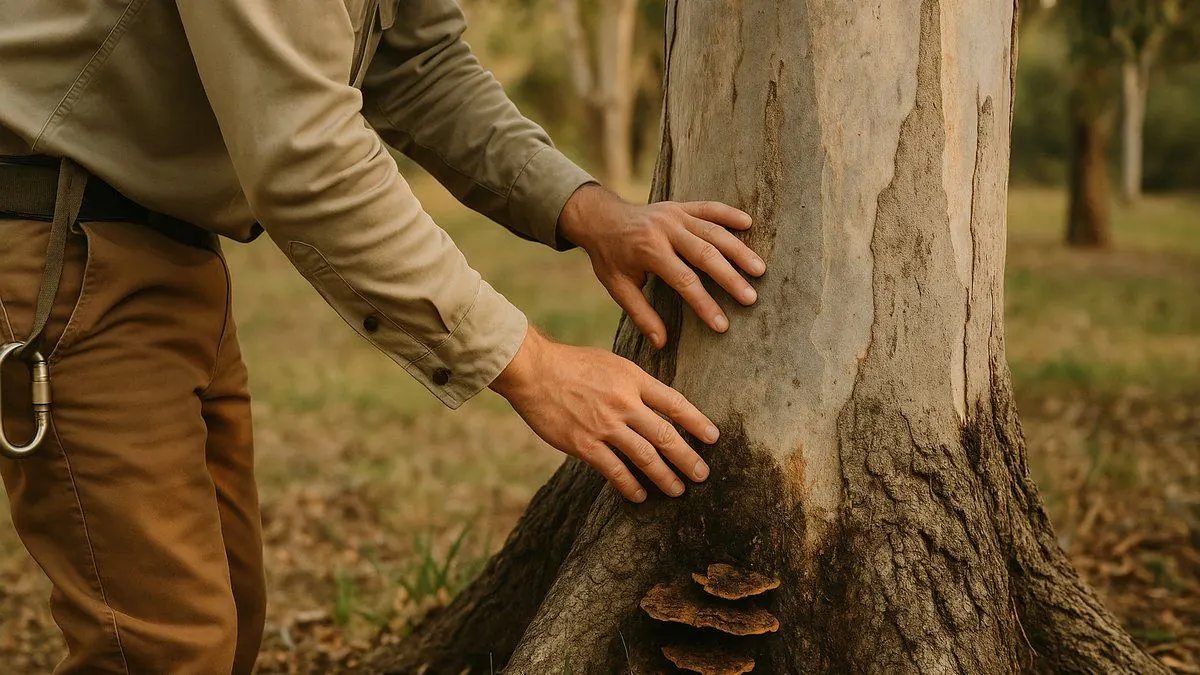
Fungal brackets at the base
Shelf-like growths emerging from the trunk near ground level (Ganoderma, Phellinus, Inonotus). Indicates internal rot. Tree could fail without warning. Get an arborist this week.
Lean has changed recently
The tree was vertical (or had a fixed lean) and now leans more after a storm or heavy rain. Indicates root-plate movement. The tree's structurally compromised. Don't park near it.
Cracks in the trunk over 5cm deep
Vertical cracks running up the main trunk, especially through codominant unions. Sign the tree is splitting itself apart. Often paired with weeping sap or insect activity.
Hung-up branches in the canopy
Dead branches that have broken but haven't fallen — caught in lower limbs ("widow-makers"). Will drop in the next strong wind. If they're over a path, car or kids' area, treat as urgent.
More than 25% deadwood in the canopy
Dead branches scattered throughout the canopy, no leaves. Tree is in serious decline. Could indicate root damage, drought stress, or terminal disease. Get an arborist report.
Soil heave around the root flare
The ground around the trunk is mounded or cracked, especially after wet weather. Roots are lifting. Tree is preparing to fail. Photograph and call.
Whole branches dying back from tips
"Crown dieback" — leaves brown and fall off branch ends, branches eventually die back into the canopy. Could be drought, root damage, or disease. Worth investigating.
Bark falling off in large sheets
Sheets of bark sloughing off and not regrowing. Different from normal bark shedding (gums) — the wood underneath is exposed and discoloured. Could indicate disease or pest activity.
Sap weeping from the trunk
Sticky discharge running down the bark, often dark or sour-smelling. Could be a wound response, but persistent weeping (months) suggests disease or borer activity.
Mushrooms growing on the roots
Different from trunk brackets. Mushrooms on surface roots within 2m of the trunk can indicate root rot. Photograph and identify the mushroom species before deciding action.
Bark shedding in long strips (gums)
Normal for eucalyptus species. Smooth-barked gums shed annually — often in early summer. The tree is fine. Don't remove.
Leaves dropping out of season
Australian natives shed leaves year-round; many drop heavily in late summer drought-stress. Doesn't usually mean the tree's dying. Worth checking, not panicking.
The simple decision tree
If anything is rated Urgent, get an arborist this week
Don't park under it, don't let kids play under it, photograph the symptom from three angles. Call 0402 522 434 with the photo.
If High symptoms cluster (two or more from the High list)
Get an arborist report within a fortnight. Tree may be saveable with a major reduction; may need to come out.
If only Medium symptoms appear
Keep watching. Photograph monthly so you can track progression. If symptoms worsen or new ones appear, escalate.
If only Low symptoms appear
Tree is probably fine. Most of what looks dramatic in summer (bark, leaves) is the tree's normal seasonal behaviour.
What an arborist actually looks for
Visual Tree Assessment (VTA) follows a defined sequence. Beyond what you can see from the ground, we check:
- Root flare visibility (buried = bad)
- Codominant stems with included bark (failure-prone)
- Cavity sounding (with a rubber mallet)
- Resistograph testing if internal rot is suspected
- Soil compaction in the root zone
- Recent earthworks within the tree protection zone
- Live crown ratio versus historical canopy
Full arborist report process — runs $400–$700 for a single-tree assessment.
When you don't need to call us
Honest things first. The following are fine:
- Annual bark shedding on smooth gums — normal December–January
- Yellow autumn colour on deciduous trees — they're meant to do that
- Leaf litter from gums year-round — that's the species
- Spider webs in the canopy — actually a healthy ecosystem indicator
- A static lean the tree's had since you bought the place — that's its growth pattern
- Lerps (sticky white scale on gum leaves) — pest pressure rarely fatal; the tree manages
Frequently asked
How can I tell if my tree is actually dead?
Three checks: scratch the bark of a small twig (green underneath = alive, brown = dead); look for any new buds or shoots in spring; check root flare for soft rot. If two of three say dead, it's dead.
My tree was hit by a storm — should I remove it?
Not automatically. Storm damage is often partial. Get an arborist to assess remaining structural integrity — sometimes a major reduction saves the tree, sometimes it's a write-off. Don't let storm chasers pressure you in the driveway.
Can I save a tree that's losing leaves?
Depends on cause. Drought stress: deep watering helps. Root damage: harder, sometimes terminal. Borer or fungal: depends on species. Get a diagnosis before treatment.
What about pest infestations?
Most pest pressure is survivable for healthy trees. Lerps, scale, sap-suckers — uncomfortable for the tree, rarely fatal. Severe borer activity in the trunk is more concerning. Photograph and call.
How fast can a tree fail?
Sudden failure (no warning) is rare. Most trees telegraph the problem for months — fungal brackets, lean change, soil heave, deadwood spread. The "tree just fell over" stories almost always have visible warning signs in retrospect.
Send a photo, get an honest assessment
0402 522 434SMS or email contact@loraxtreeremoval.com.au with photos. We'll tell you if it needs us or doesn't.